
| |

Ischaemic Changes of Different Anatomical Regions or Vascular Territories

Infarction involving the subcortical territory: Corona radiata infarct

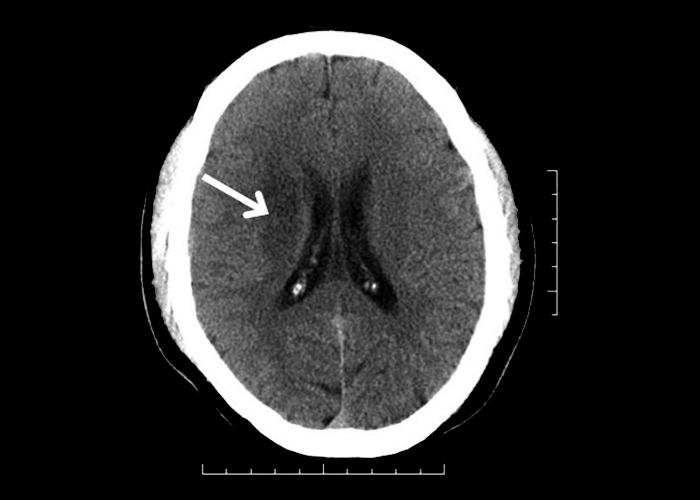
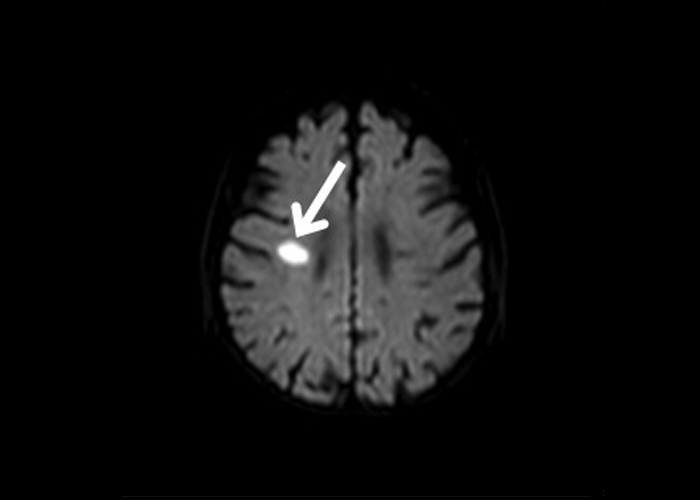
The first scan shown is a non-contrast CT demonstrating a hypodense lesion at the right corona radiata arrow_1 (Figure 1). The next scan is a MRI (diffusion weighted imaging (DWI) sequence) from another patient, also with an infarct involving the corona radiata. The scan shows evidence of “restricted diffusion” over this region arrow_1 (Figure 2). Both of these patients presented with an acute onset of left hemiparesis, slurring of speech and left facial weakness of an upper motor neuron lesion pattern.
Similar Posts

  • |

    Intention Tremor

    Intention tremor can be elicited by the finger-nose test. In normal patients, the movements between the physician’s finger and patient’s nose should be smooth, but adjustment is allowed according to the patient’s upper limb power. This man has intention tremor and impaired finger-nose test on the right side, whilst the left side is normal. Discussion on intention…

  • Osmotic Demyelination Syndrome

    This is a set of cranial MRIs from a patient with osmotic demyelination syndrome, formerly called central pontine myelinolysis. Osmotic demyelination syndrome occurs when wide fluxes in serum sodium levels are induced by too rapid correction of hyponatremia. Oligodendrocytes, which forms the myelin sheaths, are particularly vulnerable to osmotic changes. If the osmotic stress is…

  • Arterio-venous Malformations

    Cerebral vascular malformations can be classified by histopathology into 4 major types: Arterio-venous malformations (AVMs) Venous angiomas (developmental venous anomalies) Capillary telangiectasias and Cavernous malformations Arterio-venous malformations (AVMs) are congenital vascular lesions due to dysregulated angiogenesis. They are most often solitary but rarely could be multiple, in which case an underlying syndrome (e.g. hereditary haemorrhagic telangiectasia,…

  • Parkinson-plus Syndromes

    The Parkinson-plus syndromes include 1) multi-system atrophy, 2) progressive supra-nuclear palsy and 3) corticobasal degeneration. Multi-system atrophy Multi-system atrophy (MSA) is a rare adult-onset sporadic neurodegenerative disorder. There are two main subtypes, as identified by its dominating symptomatology. MSA-P is when parkinsonian symptoms predominate, and MSA-C if cerebellar symptoms dominate. These two terms have replaced…